
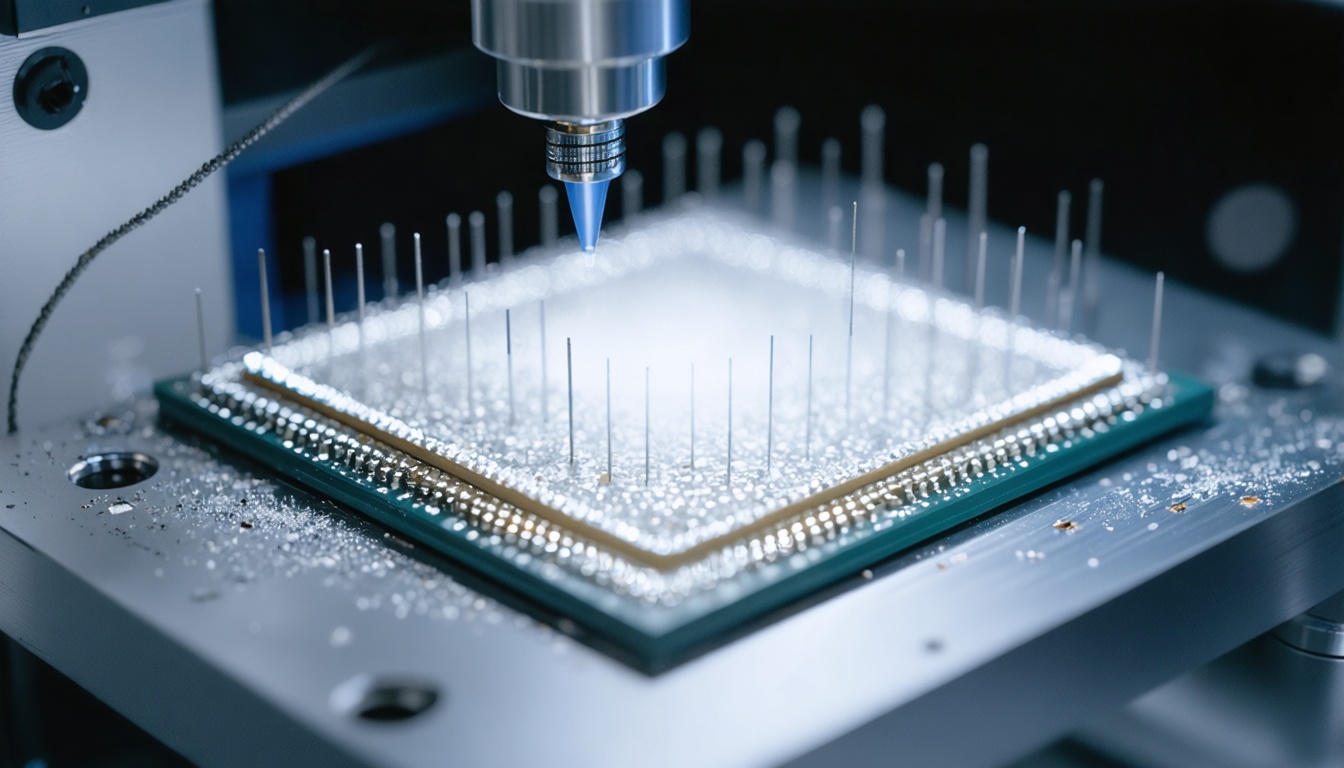
Electrical test at probe is the ultimate yield measurement. Everything that happened in the 45 to 60 days of processing before that moment either contributed to yield loss or did not. Most fabs treat inspection and probe data as separate workflows — the inspection data lives in the yield management system and the probe data lives in the tester data system, and connecting them requires manual work or periodic batch exports that lag production by days or weeks. The consequence is that root cause analysis for yield problems is always retrospective, often slow, and frequently incomplete.
The Data Architecture Problem
The technical barrier to probe-to-inspection correlation is well understood: the data comes from different sources, with different formats, different coordinate systems, and different time granularities. Probe test data typically provides die-level pass/fail results in a format tied to the prober's wafer map coordinate system — which is defined by the probe card design and the prober's stage alignment, not by the wafer coordinate system used by inspection tools. Translating a die-level probe fail location (row 14, column 23 on a 32x32 die grid) to the wafer coordinate system (X = -45.2mm, Y = +12.7mm) requires knowing the die pitch, the origin of the die grid relative to the wafer notch, and any stage offset corrections applied during probe setup.
These parameters are available in the tester recipe and the probe station setup records, but they are typically not included in the test data files themselves. The test data files (usually in STDF format — Standard Test Data Format, defined by SEMI E142) contain the pass/fail binning by die position, the test program name, the lot and wafer IDs, and the individual test results, but not the wafer-coordinate transformation needed to overlay the die positions onto an inspection defect map. That transformation has to be reconstructed from the tester recipe and the probe card specification.
Building the Correlation: What It Takes
A robust probe-to-inspection correlation pipeline requires four components. First, a die-to-wafer-coordinate transformation that is validated for each product and probe card combination. This transformation is typically defined once per product and rarely changes, but it must be validated against physical measurements (probing a reference wafer with known mark positions) before the correlation results are used for production decisions.
Second, a synchronized lot history that links each wafer's probe test result to its complete process history — which inspection steps ran, which equipment processed the wafer at each step, and what the inspection results were. This linkage requires a common wafer identifier (the wafer serial number or lot+wafer number combination) that persists from the start of processing through probe test without modification. Lot splits and merges, rework operations, and pilot lot tracking can break this linkage if the MES does not handle wafer identity preservation carefully.
Third, a spatial matching algorithm that can identify inspection defects that are co-located with probe-failing die, after accounting for the coordinate system differences and any stage-to-stage offset. Die-level probe results cover the entire die area; defects within that die are at specific sub-die coordinates. The matching needs to account for the fact that a die-level fail may be caused by a defect anywhere within the die, which is a 20-100 mm2 area at typical die sizes.
Fourth, statistical significance testing for the correlation: after identifying co-location events (defect present, die failed), the question is whether the co-location rate is higher than would be expected by chance given the defect density and fail rate. A defect density of 0.1 per cm2 and a fail rate of 2% means that approximately 0.2% of defect-die pairs would co-locate by chance even with no causal relationship. The correlation is meaningful only when the observed co-location rate significantly exceeds the chance level.
What Good Correlation Data Reveals
When the correlation infrastructure is in place, the first analysis typically produces three categories of finding that are not visible from inspection data or probe data alone. First, it identifies which inspection defect types are actually electrically killing — some defect types that appear frequently in inspection results turn out to have low yield impact because they are positioned in non-critical areas or have sizes below the kill probability threshold. Focusing inspection resources on these types is disproportionately expensive relative to their yield impact; the correlation data makes the case for reducing sampling on low-kill-probability defect types and redirecting the inspection capacity to higher-impact types.
Second, it identifies yield loss components that have no inspection signature — probe fails in zones that had no elevated defect density at any inspection step. These are either probe-level failures from causes not visible to optical inspection (gate oxide leakage, parametric failures from process drift that did not produce detectable defects) or failures from defect types below the detection threshold of the inspection tools in use. Quantifying the uninspected yield loss component is essential for setting realistic yield improvement targets — if 30% of yield loss has no inspection signal, no amount of inspection-driven root cause analysis can address that 30%.
Third, it identifies the inspection step with the highest predictive value for probe yield — the step whose defect density is most strongly correlated with probe yield, after accounting for all steps. This is not always the step closest to probe. In some process flows, a defect type detected at an early inspection step (post-STI etch, for example) has higher probe yield correlation than defects detected at later steps, because the early defect type is physically catastrophic regardless of subsequent processing while later defects are more context-dependent.
Temporal Latency: The 45-Day Problem
The 45 to 60-day cycle time between process step and probe test means that probe-to-inspection correlation is inherently retrospective — you cannot use probe data to respond to a current production excursion in real time. By the time probe data reveals that lots processed four weeks ago had elevated fail rates correlated with a specific inspection pattern, those lots are already done and the root cause may have resolved on its own.
The value of probe correlation is therefore primarily in calibrating the inspection response system: establishing which inspection alerts reliably predict probe yield problems, which ones do not, and what the threshold relationship is between defect density at each inspection step and expected probe yield. Once that calibration is established on historical data, it can be applied prospectively: current inspection results can be scored against the historical probe-correlation model to estimate expected probe yield impact, without waiting for actual probe results.
This prospective scoring is the mechanism that allows inspection-driven lot holds and enhanced monitoring to be placed on a quantitative yield impact basis, rather than a rule-of-thumb basis. "Hold this lot because defect density at Metal-1 is 3x above baseline" is a defensible hold if the historical correlation shows that 3x density elevation at Metal-1 predicts a 15-20% probe yield reduction for this product type. Without the correlation data, the threshold is set conservatively (which generates excessive holds) or liberally (which allows yield problems to advance undetected).
STDF Parsing and the Tester Data Infrastructure
On the data infrastructure side, STDF (Standard Test Data Format) parsing is the first requirement for probe data integration. STDF is a binary format defined by SEMI E142 that most automated test equipment (ATE) generates. It contains a structured record hierarchy: test records organized by lot, wafer, and die, with individual test result records for each test point on each die. Reading STDF requires either the STDF specification and a custom parser, or one of several commercial STDF tools (Mentor's STDF Explorer, PDF Solutions' Datalytics). Open-source STDF parsers in Python and C are available and are used for the initial extraction step in SynthKernel's tester integration.
After STDF extraction, the per-die binning results are aligned to the wafer coordinate system using the transformation described earlier, and the aligned die maps are stored in the same spatial index as the inspection defect maps. The spatial query that connects a defect coordinate to the die at that location then becomes a straightforward lookup against the die grid, rather than a complex geometric calculation per correlation event.
The Organization Question
Probe-to-inspection correlation infrastructure requires cooperation between the yield engineering, test engineering, and IT/data teams — three organizations that often have limited interaction in day-to-day fab operations. The yield engineers understand the inspection data and the process context; the test engineers own the probe data and the tester infrastructure; the IT team owns the data warehouse. Implementing the correlation pipeline requires each group to provide data access, format documentation, and validation support. In our experience, the organizational coordination required to build this infrastructure is comparable to the technical engineering required. Fabs that succeed with it have executive sponsorship that treats cross-functional yield data integration as a strategic priority, not a project for any single engineering team to figure out alone.